Showing posts with label Art. Show all posts

Wednesday, 13 June 2012

Matisse Museum – Le Cateau-Cambrésis


As I was in the North of France with my family, we went to visit the Matisse museum in Le Cateau-Cambrésis – his birth place.

Palais Fénelon, home of the Matisse museum

The collection, exhibited in chronological order, counts 170 works. It is interesting to see the evolution of his work throughout his career. You can view some of the works on the website of the museum (link at the end of this post).

During the first years, when he was learning the craft in the art studio of Gustave Moreau, Matisse’s palette was still full of earth colours and he was also copying still life paintings by Chardin.

Matisse then explored Divisionism, after meeting Signac in Saint-Tropez in 1904. The painting was slowly created by the juxtaposition of coloured dots and the final effect relied on optical mixing of colours, when the painting is look at from a distance. But Matisse found the technique too burdensome and only kept from it the pure colours.

Another room showed works from the Fauvism period, a movement he created with a group of painters in 1905: Marquet, Manguin, Camoin, Puy, Derain, Vlaminck, Braque, Dufy, Friez, Valtat, Van Dongen and Rouault. The trademark of the group was bright and pure colours used to express sentiments rather than depict reality.


One of Matisse's sculpture in the courtyard

Then came the paintings done with flat colours and simplified lines. Matisse was always looking for a sensation of calm and balance in his work. A feature of the artist’s work is how he uses black: to create lines but also in planes, as any other colours. In his writings and interviews, he made the point that black was a colour. He even went as far as declaring that he was using black as a "colour of light rather than a colour of obscurity".


Matisse's palette


Towards the end of his life, Matisse developed a unique technique with gouache cut-outs to create his works. The museum has some fine examples from this period.

Matisse also worked on the Chapelle in Vence (South of France) that he created for the Dominican sisters between 1948 and 1951. The museum shows several models and works specially created for this project.

On the ground floor, the museum has a large selection of drawings and engravings by Matisse.

Nus de Dos number one by Matisse

Another aspect of Matisse’s work is the sculptures he carved. The original plasters of the series Nus de Dos are in the museum. And the first one is also in the garden as a bronze sculpture (A full series of the four sculptures casted in bronze is part of the Centre Pompidou collection in Paris).

The Matisse museum also hosts the Herbin Collection (a geometrical abstract artist born in the North of France) as well as the Tériade Collection (he published a number of artists’ books, including Jazz by Matisse).


The museum

Musée départemental Matisse
Palais Fénelon
59360 Le Cateau-Cambrésis


Monday, 21 May 2012

Picasso’s quick prototyping


Quick prototyping consists in iterating quickly different versions of the same project in order to test your ideas. It is practical when the iteration is not expensive in terms of money and time.

Making a series of sketches before committing to the final composition of a painting is one form of quick prototyping. Having to correct errors at a later stage would be more painful and time consuming. I found a very good and practical example of quick prototyping by Picasso.


Françoise Gilot, in her book “Life with Picasso” explains:

“I suggested that since all the elements of the composition were perfect and it was only the question of balance that bothered him, he try the solution he had brought to my portrait: cut out the skull from a piece of paper and move it around in different areas of the canvas. He cut out another skull form and, hiding the painted one with one hand, moved the paper skull wherever he felt it might prove sufficiently disturbing. He finally found a spot that was much more unexpected than the original one and provided just the kind of fateful juxtaposition he was seeking, where the balance hung by a thread. Then he was satisfied.”

This is such a simple yet powerful way to test a change you want to make to a painting in progress. You can judge directly the visual impact of the change and also find unexpected placement of elements.

Thursday, 26 April 2012

If artists were trees

This is an unusual post born from a “what if” question. I see some connections between species of trees and some artists’ bushstrokes.

Camille Pissarro

While studying Camille Pissarro’s paintings, his brushwork reminded me of cherry trees. This analogy was brought on me not only the pointy shape of the leaves echoed by the elongated coma shaped brush marks, but also by the way brush strokes are placed on the canvas, in diagonal or hatches.


Cherry tree


The Church at Eragny (Detail)


The Church at Eragny - oil on canvas by Camille Pissarro [Source: Wikimedia]

Pissarro went through different styles. He even tried pointillism before giving it up because he found the style too contrived. The “cherry tree leaves” brushmarks are present in his matured style, towards the end of his life.


Vincent van Gogh

While walking the the woods, I came across an old oak. Look at the pattern of the bark. Then look at some of Van Gogh paintings. What do you think of the mouvement, the patterns, and the sculptural quality of the brushwork?


Oak tree bark


Vincent van Gogh self-portrait (Detail)


Vincent van Gogh self-portrait [Source: Wikimedia]


Jean-Baptiste-Camille Corot

I associate Corot’s brushwork with beech trees or willow trees because of the way the thin branches with young shoots let the light through in early spring and seem like a fine galzing on the sky.


Oil on canvas by Jean Baptiste Corot [Source: Wikimedia ]

This brushwork is characteristic of some post 1860 landscape by Corot. As for any painter, his style has evolved and the transparencies are more present in his late works.

Beech tree

Monday, 3 October 2011

Camera obscura and photography

Last week-end had a feel of summer in the South of England and we went to Lacock to visit the Abbey.


The entry of the Abbey's


A mansion has been built on top and around Lacock Abbey and at one point was the house of William Henry Fox Talbot.

The botanic garden of Lacock Abbey


Fox Talbot was a British inventor and a pioneer of photography.

In the museum, they showed an example of camera obscura, a device that Vermer used and that gave Fox Talbot the idea of building one of the first cameras.

Camera Obscura

In his book, The Pencil of Nature, William Henry Fox Talbot recalled:

One of the first days of the month of October 1833, I was amusing myself on the lovely shores of the Lake of Como, in Italy, taking sketches with Wollaston's Camera Lucida, or rather I should say, attempting to take them: but with the smallest possible amount of success. For when the eye was removed from the prism—in which all looked beautiful—I found that the faithless pencil had only left traces on the paper melancholy to behold.

After various fruitless attempts, I laid aside the instrument and came to the conclusion, that its use required a previous knowledge of drawing, which unfortunately I did not possess.

I then thought of trying again a method which I had tried many years before. This method was, to take a Camera Obscura, and to throw the image of the objects on a piece of transparent tracing paper laid on a pane of glass in the focus of the instrument. On this paper the objects are distinctly seen, and can be traced on it with a pencil with some degree of accuracy, though not without much time and trouble.

I had tried this simple method during former visits to Italy in 1823 and 1824, but found it in practice somewhat difficult to manage, because the pressure of the hand and pencil upon the paper tends to shake and displace the instrument (insecurely fixed, in all probability, while taking a hasty sketch by a roadside, or out of an inn window); and if the instrument is once deranged, it is most difficult to get it back again, so as to point truly in its former direction.

Besides which, there is another objection, namely, that it baffles the skill and patience of the amateur to trace all the minute details visible on the paper; so that, in fact, he carries away with him little beyond a mere souvenir of the scene—which, however, certainly has its value when looked back to, in long after years.
Such, then, was the method which I proposed to try again, and to endeavour, as before, to trace with my pencil the outlines of the scenery depicted on the paper. And this led me to reflect on the inimitable beauty of the pictures of nature's painting which the glass lens of the Camera throws upon the paper in its focus—fairy pictures, creations of a moment, and destined as rapidly to fade away.

It was during these thoughts that the idea occurred to me…how charming it would be if it were possible to cause these natural images to imprint themselves durably, and remain fixed upon the paper!

And why should it not be possible? I asked myself.”


The instrument with a prism Fox Talbot referred to at the beginning of this extract is another tool used by artists: the camera lucida. The principle is totally different from the camera obscura. The prism of the camera lucida allows the user to see the subject as superimposed on the paper, making it easy to trace it. The instrument folded neatly into a case and had a clamp to fasten it to the drawing board or table.


Related resources

The Pencil of Nature by William Henry Fox Talbot is available as a free eBook (including as a PDF) on Project Gutenberg.


   Technorati Tags    :                             
                                                  

Friday, 23 September 2011

Portrait of the painter Ingres by Charles Gounod

Charles Gounod, a French composer, won the Prix de Rome in 1839 and stayed at the Académie de France in Rome when Jean Auguste Dominique Ingres was its director.


Bust of Charles Gounod by Jean-Baptiste Carpeaux (Valenciennes 1827-Courbevoie 1875). Terracota, 1873. Fine art museum of Valenciennes (France) Source : Wikimedia

Gounod’s father, who was a painter, knew Ingres when he was young and Ingres probably took good care of Charles Gounod for that reason.
In his autobiography, Mémoires d’un artiste, Gounod contradicts the description of Ingres as an affected person:

“Who has not known intimately Mr. Ingres could only have about him an inaccurate and false idea. I saw him very closely, colloquially, often, for a long time, and I can say he had a simple nature, straight, open, candid and full of momentum and enthusiasm that sometimes lead him to eloquence. He had the tenderness of a child and an apostle’s indignation; he had a naive and touching tenderness and freshness of emotion which are not found in an affected person, as some said he was.”

Ingres invited the young mucisian in his studio and encouraged him to draw on tracing paper from prints of old masters’ paintings. Gounod recalled: “I did, at his side, nearly one hundred traced drawings.”


The book

"Mémoires d’un artiste" by Charles Gounod is available as a free ebook (in French) on Project Gutenberg.

Related articles


Wednesday, 21 September 2011

The Victoria & Albert museum

The Victoria & Albert museum (V&A) in London (England) claims to be “The world's greatest museum of art and design” and it is easy to believe it. It covers many areas of art, craft and design: sculptures, paintings, drawings, textile, glass, metalwork, ceramics, furniture, prints… The museum's works date from antiquities to modern times and come from all continents.

Courtyard inside the V&A


The National Art Library, located inside the museum is major public reference library.

A huge glass sculpture suspended in the main entrance

The painting gallery - in this room the paintings are still arranged in the way the Victorian did

L'immensite by Courbet

Morning by Corot

There are so many things to see that it is best to concentrate on a few sections rather than try to see everything at once and just skin over the collections. The V&A website is comprehensive and an excellent resource to make the most of your visit.


Practical information


The Victoria & Albert museum (V&A)
Cromwell Road, London SW7 2RL
England

Opening times:

10.00 to 17.45 daily
10.00 to 22.00 Fridays
Admission: free
Website: http://www.vam.ac.uk/


Monday, 8 August 2011

The Pre-Raphaelite Brotherhood wet-white technique

This article was first published in my newsletter "Notes From My French Easel" – July - August 2011. 


The most famous and often-quoted passage is from the autobiography of William Holman Hunt, one of the founders of the Pre-Raphaelite Brotherhood. In this, Hunt describes the use of transparent glazes over a wet ground and the addition of the resin copal to the paint medium.

"Select a prepared ground originally for its brightness, and renovate if necessary with fresh white when first it comes into the studio; white to be mixed with a very little amber or copal varnish. Let this last coat become of thoroughly stone-like hardness. Upon this surface complete with exactness the outline of the part in hand."

"On the morning for the painting, with fresh white from which all superfluous oil has been extracted by means of absorbent paper, and to which again a small drop of varnish has been added, spread a further coat very evenly with a palette-knife over the part for the day's work, of such consistency that the drawing should faintly shine through. In some cases the thickened white may be applied to the forms needing brilliancy with a brush, by the aid of rectified spirits."


"Over this wet ground, the colour (transparent and semi-transparent) should be laid with light sable brushes, and the touches must be made so tenderly that the ground below shall not be worked up, yet so far enticed to blend with the superimposed tints as to correct the qualities of thinness and staininess which over a dry ground transparent colours used would inevitably exhibit. Painting of this kind cannot be retouched except with an entire loss of luminosity."

Hunt, WH 1905-1906 'Pre-Raphaelitism and the Pre-Raphaelite Brotherhood'. London: Macmillan & Co Ltd., Vol 1 p276


Claudio and Isabella. (1850) by William Holman Hunt. Oil on mahogany. support: 758 × 426 x 10 mm frame: 997 × 668 × 80 mm. [Source: Wikimedia ]


This reminds me of the fresco technique where the ground is applied on a small surface that the artist can work during his session. I am sure Hunt read Leonardo da Vinci’s advice on colurs: “For those colours which you wish to be beautiful, always first prepare a pure white ground. I say this in regard to colours which are transparent, because those which are not transparent do not benefit from a light ground. An example of this is shown by coloured pieces of glass which, when interposed between the eye and the luminous air, reveal themselves as exceedingly beautiful and this they cannot do when they have behind them a shadowiy air or other darkness.”


Hunt’s technique seems very constrained and dictated the very detailed and delicate approach of some of the Pre-Raphaelite paintings. It worked very well to get luminous colours that stood the test of time. Pre-Raphaelite paintings in museums look as fresh today as when they were painted. The drawback was less spontaneity in the execution.


Related articles


Monday, 1 August 2011

Signature as insurance certificate

In her book “Life with Picasso” Françoise Gilot remember a visit she made with Picasso to the vaults he had for his paintings, at one of the Parisian bank on the Boulevard des Italiens.

Françoise Gilot noticed that the paintings in the vault were all signed where Picasso kept only unsigned canvases in the atelier.


“I had noticed that he kept only unsigned canvases in the atelier. I asked him about that. "As long as a picture isn't signed," he said, "it's harder to dispose of if it's stolen. And there are other reasons, too. A signature is often an ugly blob that distracts from the composition once it's there. That's why I generally sign a picture only when it's sold. Some of these are paintings that I sold years ago and have bought back. The rest—well, as long as a painting hangs around the atelier unsigned, I feel I can always do something about it if I'm not completely satisfied. But when I've said everything I had to say in it and it's ready to start a life of its own, then I sign it and send it over here."”


So, Picasso used his signature in a conventional and unconventional way:

  • As most artists do, he signed his work when he was completely satisfied with it. The signature acts as a “closure”. An unsigned work can always be re-worked.
  • In Picasso’s case, the signature was also an anti-theft mechanism. Only sold works leaving the studio were signed.
Related resources


If you are in the US (Amazon affiliate link)

Life With Picasso by Françoise Gilot

If you are in the United Kingdom (Amazon affiliate link)

Life with Picasso by Françoise Gilot


Friday, 22 July 2011

Art is not always about beauty


Monument to Balzac, Auguste Rodin - Photograph by Jeff Kubina (Source Wikimedia)


“And that which is considered ugly in nature often presents more character than that which is termed beautiful, because in the contractions of a sickly countenance, in the lines of a vicious face, in all deformity, in all decay, the inner truth shines forth more clearly than in features that are regular and healthy.”


Auguste Rodin, 1840-1917 in “Art”


More from Rodin

Tuesday, 19 July 2011

Humour in visual art

This article was first published in my newsletter "Notes From My French Easel" – June 2011. 


The Oxford dictionary defines “Humour” as “The faculty of perceiving what is ludicrous or amusing, or of expressing it in speech, writing, or other composition; jocose imagination or treatment of a subject.”
Humour is not often present in visual art compared to other forms of art like literature or cinema. In a painting, which is seen at once, it is more difficult to create the time laps between primary perception and meaning that trigger humour.


Slave Market with the Disappearing Bust of Voltaire by Salvador Dali (Source: Wikimedia)


Surrealist painters were good at introducing humour in their paintings. My preferred example is Dali’s painting titled “Slave Market with the Disappearing Bust of Voltaire”. He used a visual illusion with two women who look like nuns making up the face of Voltaire. The humour comes from the fact that Voltaire wrote against the intolerance in the church.

Other times, the humour I find in modern art is not intended… but that’s another matter.

Humour could be more present in painting. Playfulness is a good way to bring creativity to your work. If you are in a playful mood, you create a secure environment to experiment, to try a different way and push boundaries. “It’s just a game” opens a world of possibility. Crazy ideas do not seem so crazy anymore.


Tuesday, 31 May 2011

Abstract and realist paintings

In an interview with American Artist magazine (En Plein Air: A Conversation With Camille Przewodek, 25 Jun 2009 by Allison), Camille Przewodek said: “under every good painting is a good abstract painting.”

At a working level, this makes total sense. In order to build a strong painting, you need to establish a strong composition based on a good mapping of tones and colours. If you work in oil or acrylic in particular, this means working out the large masses before thinking about details.


Block-in stage of my painting “3 geese”

  
The way we see the world to paint it is also abstract. The painter has to abstract the subject in order to see the world as a collection of colour patches of varying degrees of darkness or lightness (see my previous article “It’s a patchy world”).

It you consider the process of creating a work in oil, abstract painting appears as a natural evolution of realism rather than its opposite. In the way I paint, the underpainting is in general spontaneous, colourful and often far from the depiction of the scene. Then, the block-in stage brings some structure but is still fairly abstract. It is only late in the process that realism emerges with the addition of details.


Rain, Steam and Speed - The Great Western Railway – Oil painting (35.83 × 47.95 in) by J. M. W. Turner [Source: Wikimedia]

  
Artists reaching their maturity often let more abstract elements into their paintings. Turner’s landscape became more and more abstract along the years. The late paintings by Monet have an abstract quality which is not only due to the deterioration of his sight.

  
The Japanese Footbridge by Claude Monet – Source: Wikipedia Loves Art participant "Opal_Art_Seekers_4" via Wikimedia


Related resources

Thursday, 19 May 2011

Trompe l’oeil paintings in Neuilly-sur-Seine

I am in Paris (France) at the moment and while walking in the nearby Neuilly-sur Seine, I stumbled across several trompe l’oeil paintings on the side of  buildings.


The whole side of one building located in the Boulevard du Général Leclerc has been painted with fake bicks and windows.


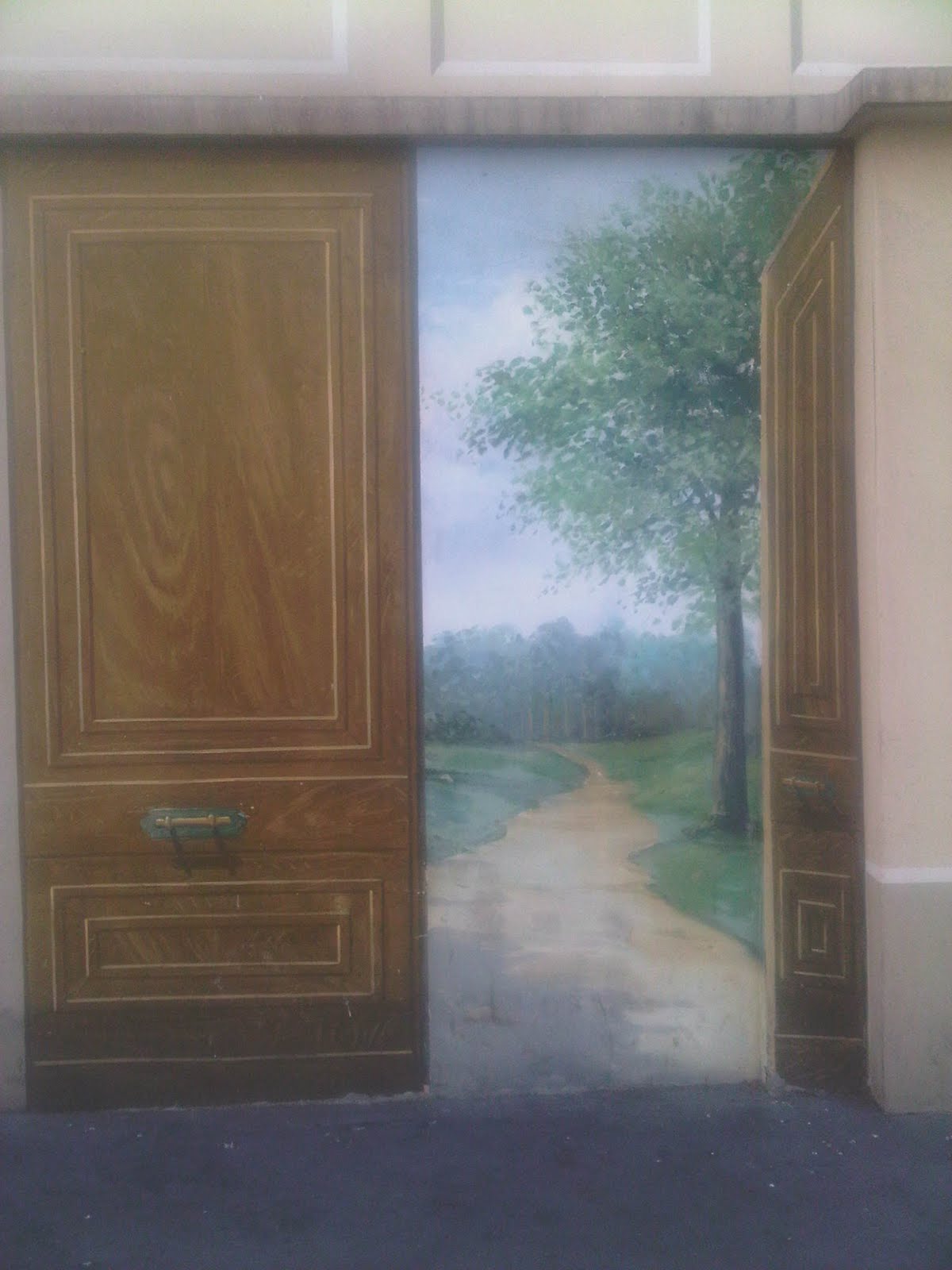
The painted door opens onto an imaginary park, as if a hidden world was inside the building.

I found another trompe l’oeil located rue Bailly. The side of the building has been populated with windows and inhabitants talking on their balconies.


At street level, there is a florist’s shop window. To enhance the illusion, the artist painted the reflection of a parked car in the window.

The nearby door on the left has a real handle affixed to it, blurring the border between reality and fantasy.


On the right side of the florist's shop, a double door opening on the countryside gives away the fact that it is a trompe l'oeil and invites viewers to escape from the city.

I carried on walking and found yet another trompe l’oeil Rue du chateau.This one is simple but works really well.


On the ground floor, the real plants growing along the wall help to blend the painted door and window into the real world.


Trompe l’œil paintings are an effective way to smuggle art into cities. They are entertaining and also have the power to make us question reality. After you spot one, you become more aware of your surrounding, wondering what is real and what is just an illusion…


Related article
 
Looking outside - mural


Friday, 13 May 2011

Oscar Wilde on art

At the moment, I am reading the Picture of Dorian Gray on my Amazon Kindle. If you know the story, a painting plays a central role in the plot.

 
When I read the Preface, I could see that Wilde’s words were speaking beyond writing and to art in general.


Three quarter length portrait of Oscar Wilde by Napoleon Sarony. Source: Library of Congress via WikiMedia

  
Quotes from the Preface

“The artist is the creator of beautiful things. To reveal art and conceal the artist is art's aim.”

“Those who find ugly meanings in beautiful things are corrupt without being charming. This is a fault. Those who find beautiful meanings in beautiful things are the cultivated. For these there is hope. They are the elect to whom beautiful things mean only beauty.”

“There is no such thing as a moral or an immoral book. Books are well written, or badly written. That is all.”

“The moral life of man forms part of the subject-matter of the artist, but the morality of art consists in the perfect use of an imperfect medium. No artist desires to prove anything. Even things that are true can be proved. No artist has ethical sympathies. An ethical sympathy in an artist is an unpardonable mannerism of style. No artist is ever morbid. The artist can express everything. Thought and language are to the artist instruments of an art. Vice and virtue are to the artist materials for an art.”

“Diversity of opinion about a work of art shows that the work is new, complex, and vital. When critics disagree, the artist is in accord with himself.”

And Wilde closes his Preface with the following ironic statement: “All art is quite useless.”

  
Oscar Wilde is almost too quotable. His writings are peppered with witty comments and aphorisms that sometimes distract you from the plot of the novel. This makes reading his work both highly entertaining and irritating. It is a little bit like listening to these too clever people who always get a laugh in society…

  
Related resources

 
Biography of Oscar Wilde on Wikipedia

 
Picture of Dorian Gray available for free on Project Gutenberg in many electronic formats, including PDF.


If you are in the US (Amazon affiliate link):


If you are in the United Kingdom (Amazon affiliate link):