Wednesday, 12 December 2007

Fingerprint Your Painting


Biometrics is big in the security world and fingerprints have been used as evidence by the forensic community since 1892. How does that relate to art?

Here is this idea: you can authenticate your painting by leaving your fingerprint in the fresh paint.

If you are prolific and become famous, this could help sorting out your works from clever fakes. As any anti-counterfeiting measure, it would be even more effective if kept it secret. A crazy idea? Just consider this:
  • It is simple enough to be implemented right now if you want to.
  • It costs nothing.
  • It is discrete and will not deface your art
A recent article published in The Sunday Times (December 2, 2007), “Police ‘dust’ paintings for priceless Leonardo da Vinci dabs” explains how the Italian police are looking for Leonardo da Vinci’s prints on two Renaissance paintings. The two paintings in question are La Madone de Laroque and Saint Catherine of Alexandria.


Some experts believe that La Madone de Laroque is by Giampietrino, an artist who worked in da Vinci’s workshop, while others believe it is a work by the master himself. The other painting, Catherine of Alexandria, is believed to be by Giampietrino.

An attribution of one or both paintings to Leonardo da Vinci would mean a dramatic increase of their financial value… Art experts' reputation is also at stake.

The article mentions that Leonardo da Vinci was using his fingers when painting:
“Studies have shown the tips of the artist’s fingers were used to create a soft-focus effect in several parts of the painting, a technique for which Leonardo is famous.

Sometimes using his blood, sweat and urine, Leonardo also blended the still malleable paint with his fingers and palms to create an effect in areas such as a face joining hair. The traces of his fingers are visible only from very close up.”

The police, with the help of the University of Chieti in central Italy and the Museo Ideale in Vinci (Leonardo da Vinci’s birthplace near Florence), have taken photographs of fingerprints on the paintings. They also have a database of 200 incomplete fingerprints of Leonardo da Vinci which have been gathered in the past three years.

The police are going to use the same techniques they use with fingerprints in criminal investigations.

It will be interesting to read their findings.


Works by Leonardo da Vinci

Leonardo da Vinci’s Notebooks
Wikipedia Entry for Leonardo da Vinci


Monday, 10 December 2007

Torquay in the rain 2 - Oil painting


I am keeping up with my challenge for my 52 Weeks - 52 Works project . Here is this week installment.

In a recent post, I talked about a quick seascape study I did while in Torquay. I wanted to make a larger painting from the study I painted on location and I have now done so.


Torquay in the rain - Oil on linen canvas (35 X 27 cm) by Benoit Philippe


I took few reference photographs (I always try to take some as back-up), but they were not great as the day was grey and the rain was getting on the camera's lens.

I decided not to use the photographs I took and to work only from the study and from memory.


The format of the canvas and the board were similar. The format of the final painting was small enough to keep the "rough" aspect of the initial study (that would not work as well on a large canvas). To make sure I was not going into to much detail, I used mostly a No. 10 hog flat brush. By painting with bigger brushes while scaling-up the format, I could maintain the same feel as in the original study.


I toned the canvas with a flesh tone colour. I then sketched the painting directly with the edge of the brush. The composition was simple and putting in place the masses directly was not a problem.


There are few differences between the original study and the final painting on canvas:

  • In the final painting, I showed more sky and less sea. I found it gave a better balance to the composition.

  • The colours of shadows on the sea are richer. You can see traces of dark green and ultramarine blue.

  • I used a richer mix with heavy strokes to paint the rocks and the ripples on the surface of the water.

  • For the sky, I used glazes over the fresh grey paint. I added some clear highlights around the trees and the distant coastline so that they stand out.

I hope you enjoyed looking at this painting as much as I did painting it.


Friday, 7 December 2007

Travel With Artist Oil Paint

Following my article on travelling with your pochade box, and the end of the year holidays arriving, I thought it would be a good idea to round-up some articles and resources I found on the subject.


Articles online


Material Safety Data Sheets (MSDS) online

One of the essential preparations when you travel with oil paints is to carry with you the relevant Material Safety Data Sheets (MSDS). If customs officers start to challenge the fact that your paint can go on the plane, the MSDS is the best way to convince them.

Not all paint manufacturers make the effort to post their MSDS online (difficult to understand why), so I would like to give bonus point to the companies below for doing so:


Wednesday, 5 December 2007

Drawing and Painting Trees


Autumn is a good time to admire trees. Within a month, beeches went through dramatic changes: the green foliage turned yellow, then orange… Now, the brown leaves have started to fall, revealing the structure of the trees. Autumn is a magnificent season. Trees get on the warm side of the palette. Acers are in fire.

From a painter point of view, trees provide structure, verticals in the landscape, pointers to lead the eye of the viewer towards the horizon and reinforce the aerial perspective.

Five points to explore for artists:

  • Learn about trees: go to your library and borrow books on trees. Naming is starting to understand.

  • When drawing, get the overall shape of the tree first: Observe trees at dusk, when the dimmed light flattens the shapes and gives you a general outline. Another way to observe the shape of trees is to look at them in the light. Finally, guide books on trees often have a silhouette of each tree to help you identify a particular specimen.

  • Paint and draw from nature: The same tree will grow differently if it is part of a group or an isolated specimen. Each tree has a particular rhythm, movement, personality. Rely on your observation skills.


  • Paint and draw trees in all seasons: In winter, deciduous trees are bare and it is easy to see the shape of branches. In spring, the leaves bring colours, but the trunk and branches are still apparent. During summer, enjoy the full green foliage. In autumn, catch the riot of colours.


  • Use negative shapes: rather than drawing intertwined branches, concentrate on the shape framed by these branches.

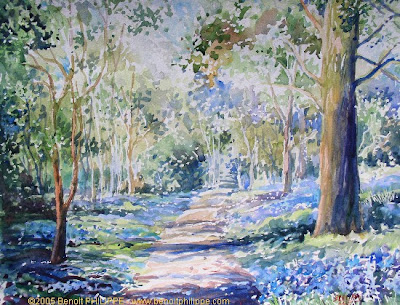
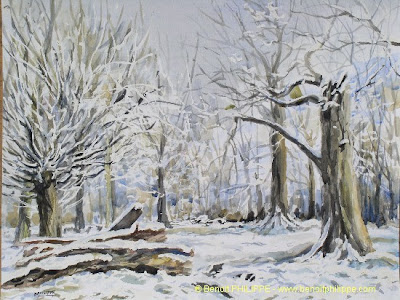
Trees around the year in 4 paintings


Spring


Summer


Autumn


Winter


Monday, 3 December 2007

Working In Batch: The Artist Way


Working in batch is a very effective way to save time. According to Mark Forster , the author three books about time management and personal organisation:

“One of the basic rules of time management is that it is much faster to group similar actions together. This rule is the basis of the batching which I advise in Do It Tomorrow.”


Why working in batch?
As already explained, working in batch will save you time. But there is more to it from a productivity standpoint.


Preparation time stays the same, whether you get ready for one action of several similar actions. Some examples will illustrate this:
  • Getting your tools out to apply gesso on painting boards

  • Switching on the computer and starting Windows and other programs

  • Getting you contact list out to make phone calls

Tools and material required are the same for batched items: This is a principle developed by David Allen in his book Getting Things Done: The Art of Stress-free Productivity (also known as GTD). You should group your tasks by context. If you have a section of your to-do list which is called “@call”, you can make all your phone calls at the same time. (Other examples of context: “@errand”, “@studio”, “@computer”)

Easier to spot areas for improvement: When you repeat a task several times, it become easier to spot whether your process is efficient and how you could change it. Let’s put it this way: if you only perform a task once, it does not make the great difference if you don’t do it in an efficient way. If you repeat the task 10 times, you should at least notice its inefficiency, you will probably get irritated to the point that you will find a better way.

You get the advantage of training. If you repeat the same task over and over again during the batching process, you will get better at it and more efficient. In some cases, it also removes the fear you have to accomplish certain tasks. If you hate cold calling prospects, making all your calls in one go will ease the pressure. The first call is always the most difficult one.

Save money: When I prepare MDF boards with tinted gesso, I mix a large quantity of gesso tinted with acrylic paint in an old ice-cream tub. I then apply the gesso onto the panels I cut earlier until I use it all. I make sure that I cut plenty of panels to use the gesso I have prepared. If I am left with couple of bear panels, they just wait until I prepare the next batch. This way, I am not wasting any gesso.

What can you work in batch?
Things you do everyday: Leo Babauta from Zen Habits wrote in his article “Haiku Productivity: Limit Your Work Week”:
“Batch. If there’s something you do every day, consider batching it all into one day. For example, I was writing my Zen Habits posts every day, but now I do it all at once. And in truth, it saves me time. You could do that with almost anything. Same thing goes for something you do throughout the day, like email or phone calls. Consider batching tasks like that into one session per day.”


Small tasks

It is a good idea to batch small tasks and do them in one go at the end of the day, when your level of energy is lower.


Apply the batch method to the structure of the task


This idea is credited to Mark Forster who illustrates the point in his article “Similar Actions” with the most rational way to set-up a room for his seminar. I will use instead a personal and seasonal example for artists. It is time to prepare New Year cards for my contacts. Rather than buying cards (or having them printed), I decide to make them using a photograph of one of my paintings. The steps to get this done are:
  1. Print the legend on the back of the card (title of the work, dimension, my name, address of the website) using my computer and printer.

  2. Glue the photograph on the front of the card

  3. Write the card and the address on the envelope

  4. Put the stamp on the envelope
I could go through step 1 to 4 for the first card and start all over for the second card and so on. You realise that it would be much quicker to print all the legends on the cards at once (step 1), then to glue the photograph onto all cards in one go (step 2), etc.

Let’s list some activities that lay themselves well to the “working in batch” method.

Artist’s job
  • Preparing board panels for oil painting

  • Making small canvasses

  • Cutting watercolour paper

  • Varnishing paintings

  • Framing Pictures (or get your frames made)

  • Preparing labels for your works

Art business
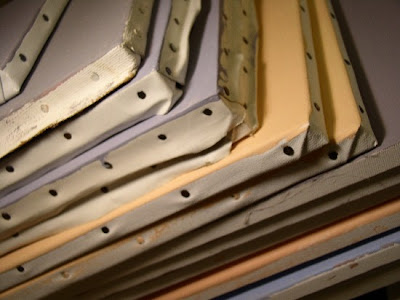
  • Buying in quantity. You know you will need ten canvasses of a given size during the months to come: buy them in bulk. You may find a good deal because you buy in quantity. You also save time because you don’t need to run to the art shop each time you want to start a painting.


Photograph: Petr Kratochvil
  • Processing emails: One word of caution, here. Don’t wait until your inbox is overgrown and you can’t see the end of it. Processing emails in batch, once or twice a day in much more efficient than checking it every 10 minutes (unless you are waiting for a confirmation that you get this big commission…)

  • Producing or writing postcards to collectors

  • Updating your website with new paintings

  • Writing posts for your blog

  • Uploading photographs onto your computer
  • Processing your expenses
These are only examples and I would love to hear about your own practice. Feel free to contribute and share your own experience by leaving a comment.

For this to work, you need some minimal organisation, so that you are ready to proceed when you decide to work on a batch of tasks. Here are two examples:
  • Expenses: keep all your receipts in an envelope (one envelope per month if you get many receipts)

  • Keep a list of works that you want to get framed. This way, you won’t forget any when it is time for your next trip to the framer

Related Articles
Further Reading