Monday, 29 June 2009

Three onions - oil painting


A simple subject: just three onions on a tea towel, but much fun painting them.
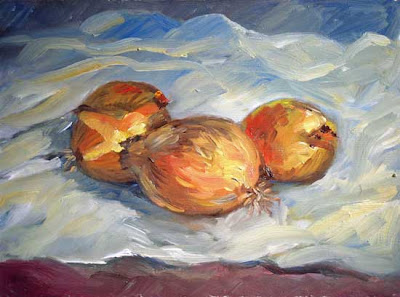
Three onions - oil on panel (6"x8") by Benoit Philippe

Tuesday, 23 June 2009

Camoin on working at your art away from your easel


«Since my arrival (8 days), a marvellous period of sunshine and I started to get into it seriously, to recognise a little bit the character of this region, but today I have to stop, grey weather, I took advantage of this to visit around the village and I realised that when we look at nature while trying to make sense of it and to understand it in order to memorise it, we work as much as if we had brushes in our hand. And this is the only way to watch; otherwise you don’t see. »

Charles Camoin – letter to Matisse sent from the Hôtel des Lions, Martigues (Bouches-du-Rhônes) on 2nd December 1904 - in “Correspondance entre Charles Camoin et Henri Matisse” - by La Bibliothèque des Arts.


Additional resource

Wikipedia article on Charles Camoin


Add to Technorati Favorites


Wednesday, 17 June 2009

Correspondence between Camoin and Matisse

This article was first published in my newsletter "Notes From My French Easel" – Mai 2009. 


I just read the correspondence between Charles Camoin and Henri Matisse (Presented and annotated by Claudine Grammont and Published in French by “La Bibliothèque des Arts”).


Born in Marseille on 23rd September 1879, Camoin died in Paris on 20th May 1965. He attended the Ecole des Beaux-Arts in Marseille and then in Paris and became part of Fauvism with Puy, Manguin, Rouault, Matisse and Marquet. The later was a close friend of both Matisse and Camoin and is frequently mentioned in their letters. The three of them went to Morocco in 1912–13.

The correspondence covers the first and second World Wars and both artists tried to help each other, morally but also in concrete ways. For instance, Matisse sent on several occasions some parcels with necessities to Camoin. During World War I, Camoin was mobilized and served as stretcher-bearer and then as a painter for the camouflage unit.

The two friends shared their work, their thoughts and their doubts. Talking about Seurat and himself, Matisse wrote in 1915: “I know that Seurat is everything but a romantic, that I am a romantic, but with a good half of science, of rationalism, that make the struggle from which I something emerge the victor, but out of breath.”

Matisse tried to join the army but his application was rejected. On several occasions, he tells in his letter how he worked hard and it was his way to go through this troubled period. Camoin was kept away from Paris and the art world during the war and this may explain why he is not very well known today. In a way, Camoin was painting by proxy through Matisse. He wrote to his friend: “You are right to work as this generation is pretty much lost and at least someone like you needs to represent it.”

During World War II Camoin lived mainly in St Tropez and Matisse and Camoin kept writing to each other from time to time. When his wife and daughter get arrested, Matisse wrote to Camoin who supported him and tried to help.

The most revealing letter was for me the one dated 12 August 1941, where Matisse asked Camoin a detail about an old anecdote. This question tells a lot about the relationship and sometime rivalry between Picasso and Matisse:

“Jean Puy told me that during World War I, there were two different sections of the camouflage unit, one headed by Segonzac and the other…. By whom? Anyway, each had a rabbit as mascot which names were Picasso for one and Matisse for the other. In comparative discussions about the two animals, no mention was made of rabbits, but it was said: “Our Picasso is more beautiful than your Matisse!” Who led the second section?”


Related articles


Monday, 15 June 2009

Ideaspotting: How to Find Your Next Great Idea by Sam Harrison


Sometimes, it seems that we are running out of ideas, repeating ourselves, and we need something fresh and different – a new idea. The book Ideaspotting: How to Find Your Next Great Idea by Sam Harrison is all about this.

The author coined the title of his book on the word “trainspotting” (which describe the activities of train fanatics who try to sight as many different trains as possible and keep lists of them).


My copy of the book with multiple bookmarks for pages I want to go back to


The book is a quick read, well designed with an elegant typography and sepia illustrations. Points made are illustrated by real world stories on how entrepreneurs turned around their businesses after spotting ideas. There are also inspiring quotes along the way.

It is the sort of book you can pick and dip into at random. The book alternates explanations and practical exercises with flow charts, checklists and questionnaires. It starts your journey by exploring your current world and then expands to the outside, teaching you how to use all your senses to get new ideas. There are also parts on networking and listening and how to get ideas from others.

Although it has been written with the designer or marketing person in mind, the techniques described will serve well any artist or creative person and will also help you on the business side of your practice.

Here are 3 things I really liked in this book:

  • The “Wow worksheet” (page 107) is an exercise inviting you to study how people react so that you can better understand how to create yourself a “wow” factor.


  • “Explore the masters for material” (pages 124 and 125) is just what the title says: exploring the work of masters to admire in order to see what you can borrow from your own work.


  • “Build an antibiosis file” (page 231): As the author expplains, “Antibiosis means a restoring to life from a death-like condition.” The concept is that you should keep a file of rejected ideas and review it on a regular basis. You never know where old ideas combined or viewed in a different way will lead you.


The activities you will find in this book and the ideas you should generate by trying some of the techniques explained will keep you busy for a long time.

Related articles and resources

Ideaspotting: How to Find Your Next Great Idea

Paperback: 256 pages
Publisher: How Design Books (28 Jul 2006)
Language English
ISBN-10: 1581808003
ISBN-13: 978-1581808001
Product Dimensions: 18.3 x 13.2 x 2 cm


Sam Harrison’s web site
Zingzone


Add to Technorati Favorites

Friday, 12 June 2009

On the beach at De Hann

The girls where playing well on the beach at De Hann (Belgium), although the weather was grey and windy.

On the beach at De Hann - oil on canvas board (6" x 8") by Benoit Philippe