I am sure you wonder what the Greek sculptor Phidias, the painter El Greco (himself from Greek origin, but adopted by Spain) and road markings have in common… Let me put them in perspective, starting with Phidias.
In the golden age of Athens, a contest had been organized to create a statue to the glory of Athena. The statue of the deity was to be erected on top of a column. Two sculptors, Alkamenes and Phidias, entered the contest. When both statues arrived, Alkamenes’ one was admired by the crowd. On the other hand, Phidias’ statue raised outrage: it seemed all wrong with its mouth wide open, a distended nostril and elongated limbs. But Phidias had the last laugh. When his statue was put on top of the column, it looked perfect, while the one by his rival seemed deformed. Phidias knew about optics and geometry and has taken into account the effect of perspective on an object placed high when he carved his statue.
Paintings by El Greco can be immediately identified by his slander figures. For a long time, I wondered about this. Then, it stroke me: the reason El Greco painted this way is that many of his paintings featured religious scenes and were to be hung in churches and cathedrals. I am sure you noticed that paintings in churches are generally hung high, the bottom of the frame being two or three metres off the ground. Like Phidias, El Greco took into account how his painting would look like from down below.
This is just guts feeling. I have not done extensive research on this and I don’t have any circumstantial evidence (like letters from the artist or testimonials from his time) to back-up this theory. It just feels right. It’s like one of these things that look evident while you have seen them.
Another disclaimer: I have not read extensively on El Greco yet, and may be this has been already explained by art scholars… If you know about particular studies pointing to this, I would be most interested to get the reference. Please leave a comment at the end of this post.
To illustrate the point, let’s take the example of the painting Adoration of the Shepherds , which was painted by El Greco for the altarpiece of his own tomb. The shepherds in the foreground look like elongated giants.
In the golden age of Athens, a contest had been organized to create a statue to the glory of Athena. The statue of the deity was to be erected on top of a column. Two sculptors, Alkamenes and Phidias, entered the contest. When both statues arrived, Alkamenes’ one was admired by the crowd. On the other hand, Phidias’ statue raised outrage: it seemed all wrong with its mouth wide open, a distended nostril and elongated limbs. But Phidias had the last laugh. When his statue was put on top of the column, it looked perfect, while the one by his rival seemed deformed. Phidias knew about optics and geometry and has taken into account the effect of perspective on an object placed high when he carved his statue.
Paintings by El Greco can be immediately identified by his slander figures. For a long time, I wondered about this. Then, it stroke me: the reason El Greco painted this way is that many of his paintings featured religious scenes and were to be hung in churches and cathedrals. I am sure you noticed that paintings in churches are generally hung high, the bottom of the frame being two or three metres off the ground. Like Phidias, El Greco took into account how his painting would look like from down below.
This is just guts feeling. I have not done extensive research on this and I don’t have any circumstantial evidence (like letters from the artist or testimonials from his time) to back-up this theory. It just feels right. It’s like one of these things that look evident while you have seen them.
Another disclaimer: I have not read extensively on El Greco yet, and may be this has been already explained by art scholars… If you know about particular studies pointing to this, I would be most interested to get the reference. Please leave a comment at the end of this post.
To illustrate the point, let’s take the example of the painting Adoration of the Shepherds , which was painted by El Greco for the altarpiece of his own tomb. The shepherds in the foreground look like elongated giants.
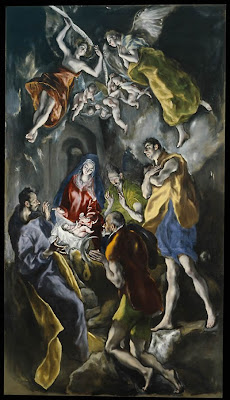
As a rudimental experiment, I printed this picture, placed it on a small easel and took a picture from below at an angle. The effect is exaggerated because of the small size of the reproduction and the steep angle of the camera, but it gives you an idea of what I am talking about.

The interesting thing about El Greco, it that this way of painting elongated figures transferred to his style and became one of his trademarks, even when the smaller size of the painting did not warrant the use of this perspective trick. You can see this on his portrait El caballero de la mano en el pecho.
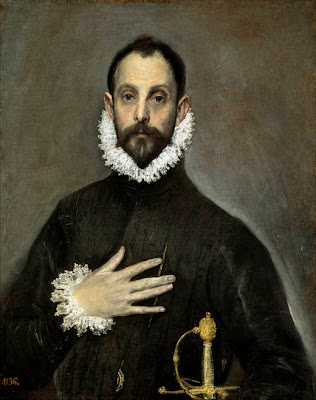
El caballero de la mano en el pecho. Oil on canvas. 81,8 x 65,8 cm. Museo del Prado. Madrid (Spain).
We talked about Phidias; we talked about El Greco; this leaves us with the road markings. They are a modern illustration of the same principle: road markings such as direction arrows or road numbers are painted in an elongated manner to take into account perspective and be visible to motorists.
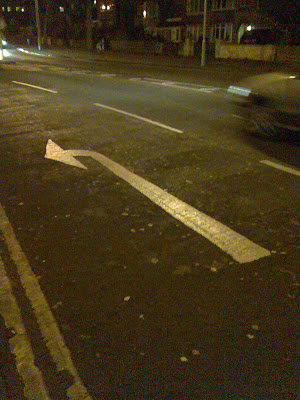
This brings us to the end of our journey.
Related resource
The Museo National del Prado in Madrid has several El Greco's paintings in the collection.
Phidias Alkamenes El Greco Perspective Art history Museo del Prado