Thursday, 29 November 2007

The Art of Ordinary


Beauty can be overwhelming for an artist. I was struck by a postcard that Matisse wrote to Bonnard from Tahiti, Pateete, on 6 June 1930:

« Ai vécu 20 jours dans une « île de corail » : lumière pure, air pur, couleur pure : diamant saphir émeraude turquoise. Poissons mirobolants. N’ai absolument rien fait excepté mauvaises photos. » [Quoted from the Matisse / Bonnard Correspondence 1925-1946 (Gallimard – ISBN-10: 2070722376 – in French)]

We can translate this as:

« Lived 20 days in a «coral island» : pure light, pure air, pure colour: diamond sapphire emerald turquoise. Fabulous fishes. Did absolutely nothing except bad photographs. »
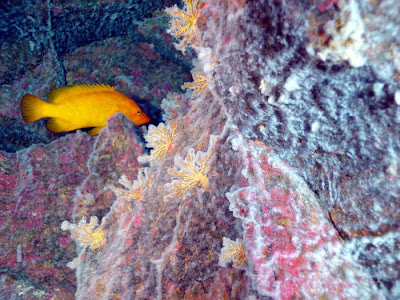


Source: http://www.photolib.noaa.gov/index.html
Location: Mariana Arc region, Western Pacific Ocean
Credit: Pacific Ring of Fire 2004 Expedition. NOAA Office of Ocean Exploration; Dr. Bob Embley, NOAA PMEL, Chief Scientist


In the case of Matisse, this beauty was not lost forever. I can see the influence of this experience years after, in Matisse’s cut out papers.

The power of the artist is to turn ordinary subjects into extra-ordinary works. I find a particular strength in everyday subjects because it is like waking-up viewers to their surrounding. You paint a building and people who have lived in town for years suddenly realise its existence. Beautiful landscapes don’t need any help from artists to get noted.

The artist faces a dilemma. New scenery brings many potential painting subjects because of its novelty. However, the lack of familiarity with the location makes it more difficult to capture the mood of a particular place. On the other hand, you live in a place for too long and you don’t see it anymore. As Picasso said: “Seeing, this is what is difficult, we are seeing sometime, rarely. We are watching without seeing.” (« Voir, c’est ça qui est difficile, on voit parfois, rarement. On regarde sans voir. » - Picasso quoted by André Verdet in his book “Picasso et ses environs”)
We need to learn to see as an artist, to see a painting in the landscape, right before our eyes.

You can develop strategies to revive the novelty in the familiar:

  • Painters will paint the same spot again years after a first attempt. They also travel to the same locations at regular intervals, learning each time a little bit more about the place while discovering it again each time.


  • Developing over time a series of works based on the same place.


  • Painting as part of a group to see how other painters capture the subject. Impressionist painters did this a lot. Cézannes and Pissarro went together to paint landscapes that Pissarro had first painted in the late 1860s.


Monday, 26 November 2007

Travelling with your pochade box


Cars, trains and boats are not an issue. What about planes?


Couples of years ago, I took my pochade box on a trip to San Francisco. I passed the security without problem (although security officers may be more difficult with the raised security measures - there are for the moment some restrictions on the quantity of liquid you can take in your hand luggage for instance).

The key is to be prepared:
  • Obtain from the manufacturer all the Health & Safety Information. I am using Winsor & Newton paint for my pochade box because all their Health & Safety Information datasheets are posted online and therefore easy to find and print;
  • Do not take flammable product on board of a plane. The Sanodor solvent has low-flammability and can therefore go on a plane. With current security measures, you will have to pack it in your suitcase, well wrapped and protected. Put a print out of the Safety Datasheet with the bottle in case Security opens your suitcase to check it.

Related articles


Saturday, 24 November 2007

"Gift Exhibition”: Painting exhibition at Swindon's Art Centre


I am taking part in the "Gift Exhibition”. This is a collective art exhibition taking place at the Art Centre in Swindon, from November until 20 December 2007.
This is an ideal time (Christmas) to offer original presents... and what's more original than a painting or a piece of art?


Invitation with the list of artists taking part

I have one watercolour, titled "Relaxing at Mevagissey". If it sells, I will show another one.


Where and when


“Gift Exhibition”
13 November - 20 December 2007


Arts Centre,
Devizes Road,
SN1 4BJ Swindon


Friday, 23 November 2007

Torquay in the rain


I did this quick study in Torquay, around 5:00 pm. The light was grey at the end of the day and it was raining.


Oil painting is not water soluble, so you can paint even if it is raining. The issue you encounter is that the rain makes the panel slipery and the paint does not adhere correctly to the support first. The oil makes an emulsion in the water and form some tiny bubbles. The consequence is that small spots of the board's ground are showing.


Torquay in the rain - Oil on panel (6"X8") by Benoit Philippe

I like the greys and the browns I used in this painting. They remind me of 19th century works.

I plan to make a small canvas based on this study.


Wednesday, 21 November 2007

Bonnard: working in batch and creative process


Working creatively in batch seems an oxymoron, because we associate traditional artistic creativity with originality and uniqueness. Art history tells us otherwise.

Andy Warhol’s methods took to the extreme the idea of working in batch, or in his case, on the production line model. He would have photographs endlessly screen printed on canvas by his assistants. It is not for nothing that he nicknamed his workshop “The Factory”.

Even before him, you can find examples of artists taking advantage of the working in batch method. Pierre Bonnard, the French Nabis painter, used to paint on pieces of unstretched canvas juxtaposed on the wall, in rows and near each other. He would work on eight or ten paintings at the same time, mixing one colour and applying it onto the canvasses in progress, on the wall. You can read a full account of Bonnard’s method illustrated by some photographs of the artist at work on the website of the New-York MoMA.

I can see several advantages to Bonnard’s working method:
  • By working on several paintings at the same time, using the same colours, he built a cohesive body of works, even when the subjects were different.

  • The tapestry of paintings on the wall would act as a mood board and keep him inspired. It is difficult to quantify the crossed influence between the works, but it must have happened.

  • Economical use of the paint: More than often, you squeeze too much paint on the palette. It is more practical to mix larger quantities of paint in order to make sure you don’t run out in the middle of a session. Bonnard could minimize the amount of paint wasted by using the mixed paint on several canvasses at the same time.

Related Resources